

Origin Neuron Gaming Desktop Review
From outset glance it's clear that the Origin Neuron means concern, and when I say business I hateful serious gaming business. Flashy RGB lighting, meridian of the line components, and a clean artful make information technology ane of the all-time looking builds I've ever laid my optics on. This isn't your standard pre-built desktop with cheaper or proprietary generic hardware that you can't upgrade down the line. With the exception of the standard 360mm water cooling, the Neuron uses completely off the shelf gear inside.
Using Origin'due south online configuration tool, nearly every component on the Neuron can be customized. You can build an entry-level organization, a powerful gaming rig, an all-out workstation beast, and annihilation in between. The specs of the beastly unit we reviewed are equally follows:
- Case: Phanteks Enthoo Evolv
- Processor: Intel Core i7 7700K Quad-Cadre 4.2GHz (four.5GHz TurboBoost)
- Motherboard: Asus Strix Z270G
- Memory: 32GB M.Skill TridentZ RGB 3000MHz (4 X 8GB)
- System Cooling: Origin Frostbyte 360 Sealed Liquid Cooling System for 1151 Socket
- Graphics Cards: Dual 11GB Nvidia GeForce GTX 1080 Ti Founders Edition
- Power Supply: 850 Watt EVGA SuperNOVA G3
- Power Supply Sleeved Cable Color: White Individually Sleeved Cables EVGA
- Hard Bulldoze One (Bone): Samsung 960 Evo 250GB M.2 SSD
- Hard Drive Ii: 2TB Seagate 2.5" FireCuda Flash-Accelerated Hard Bulldoze
- Hard Drive Iii: 2TB Seagate 2.5" FireCuda Flash-Accelerated Hard Drive
- Operating Organisation: Windows 10 Home
- Price as configured: $3799
The visual appeal of the rig is merely every bit impressive as the internal components. The Phanteks Evolv case is a nice choice for this mATX build. I similar the large drinking glass side panels which show off Origin'due south cable management very well. Inside the case, yous'll find some expanded cream which does a good job of protecting the Neuron during shipping. With dual GTX 1080 Ti'due south inside, in that location's a lot of weight that yous don't want moving around. Glad to run across this given the price of the system.

As you can tell, this is a serious gaming rig. At that place really much room for improvement unless you make up one's mind to go for a Core i9 and even so yous wouldn't be getting more gaming performance out of more than cores. The organisation can come factory overclocked too merely your results volition depend on binning. The CPU in our unit of measurement runs at 5.2GHz and the GPU has a 120MHz boost equally well.
If y'all ever need to upgrade a component down the line, information technology's as easy as if you built the rig yourself. Everything within is name brand and easily accessible. Looking at component pick, at that place's naught I would really modify here. The organization should run swell for many years down the road. The internal components are hands accessible thanks to the large, hinged side panels. They open outward almost like a bird flapping its wings. It'southward a really cool blueprint on the example just I only wish they were secured a piddling more. The corners do accept rubber covers but they hands autumn off and don't do a good task of holding the doors close. I retrieve a arrangement of magnets could work well here.
Inside you'll discover plenty of Asus Aura Sync RGB goodness to suite your gustation. The residual of the built is very clean. With a PSU basement and express front end panel I/O, all of the non-essential cables are subconscious from view. This highlights the all white PSU cabling. While it looks great, I'g not sure about the nada ties on the cables. If you are going to go to the trouble of individually sleeving your cables, why ruin the look past tying them all together? However, if this is the only minor matter I can find to complain virtually, yous tin can tell how much I like this build.

As with all SLI builds, especially those including Founders or other reference edition cards, the Neuron can get pretty toasty and loud inside. The top GPU was consistently xx degrees hotter than the bottom, but this is to exist expected. Rather than a 360mm radiator in the front, maybe Origin could have incorporated smaller radiators for the graphics cards since that's the only area where the Neuron is lacking. Overall though, temperatures are fine for the build. I was surprised though that at that place are no fans on the top of the example. The Neuron has iii intake fans only only 1 exhaust fan so I think an additional fan or two at the top could help with convection. They could even make them RGB.

Around the dorsum we find more than proper cablevision management. Everything is zip tied into position and tucked into the corners equally much as possible. Here is where the two two.five" 2TB drives are positioned. They can hands be swapped out for SSDs in the time to come. The back panel also features a small cutout directly over the drives. I think information technology works best for showing off your SSDs rather than the backs of standard HDDs, but that'south not really an result.

In the bottom left corner we observe the ii GTX 1080 Ti's in SLI likewise as the PSU basement. I really like the new high bandwidth SLI bridges equally opposed to the old strips. There is as well a small-scale cutout in the basement shroud to evidence off the power supply and its specs.

The front console is easily removable, revealing a dust filter and the triple radiator in the front end. The fans are protected with a very large dust filter that covers the entire front panel. It tin easily be pulled off for cleaning. On meridian of that are two USB 3.0 ports as well as headphone and microphone ports. If you aren't using any of the front panel connectors, in that location is a flap on the front of the case that tin fold downward to cover them upwardly.

Effectually the rear we find all of the I/O for the Asus Strix Z270G. This includes connectors for the Wi-Fi antennas, a USB 3.1 Type-C port, a USB 3.i Type-A port, an HDMI output, DisplayPort, two USB 2.0 ports, 4 USB 3.0 ports, a PS/ii port, a gigabit ethernet port, and finally the standard 6-port sound configuration. Beneath that are the video outputs from the two stock GTX 1080 Ti's. Next to that is the 120mm frazzle fan. It can be upgraded to a 140mm fan if you lot desire and tin also exist positioned up and down depending on what CPU cooling configuration you have. The last affair of notation on the back is the eco mode on the power supply. This keeps the fan off for low to medium loads.
I've talked a lot well-nigh customization with the Neuron, but you really won't need to exercise whatsoever of it for a long time. In one case you lot become the PC, all you need is a keyboard, mouse, and monitor and yous're ready to game.
Benchmarks
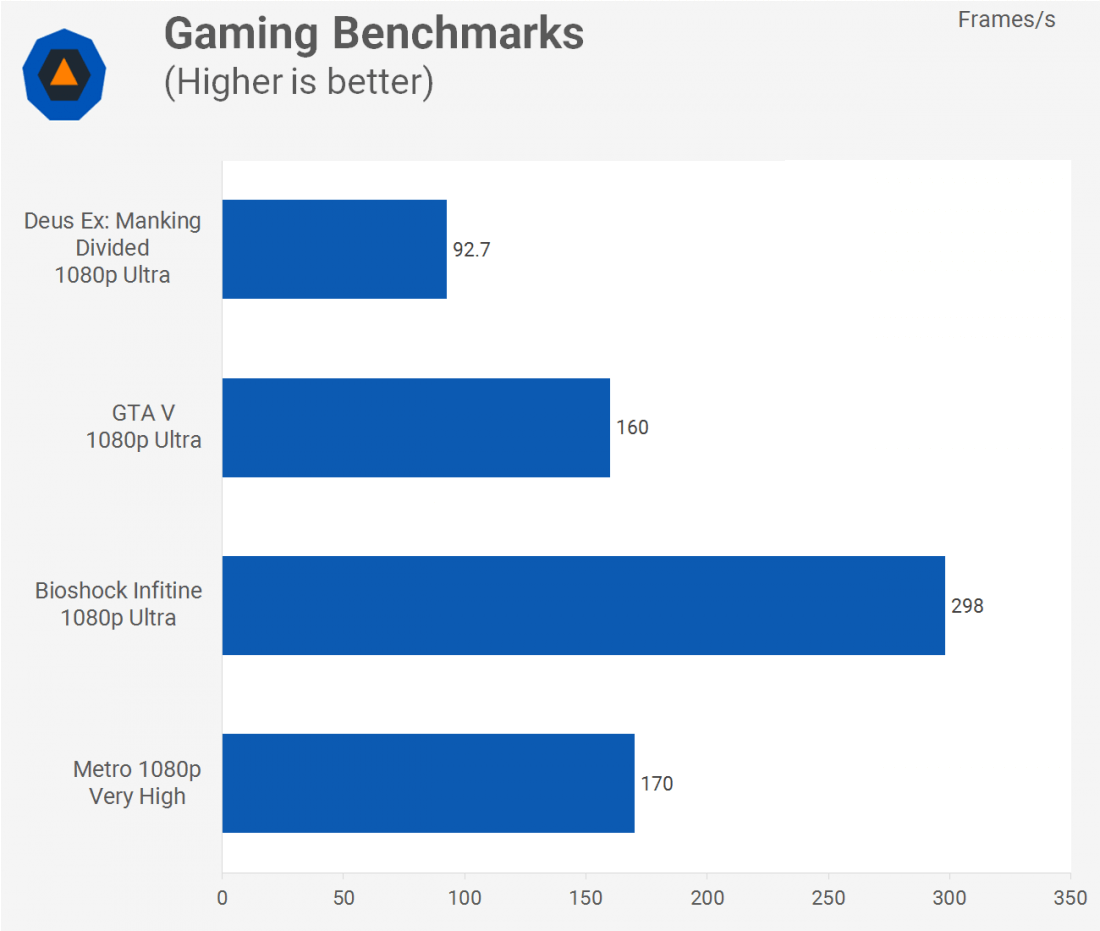
As expected, the Origin Neuron puts up massive performance numbers. When y'all're paying nigh $4000 for a PC though, annihilation less would be a thwarting. The Neuron is the fastest pre-built PC we have ever tested, and amongst the most powerful gaming systems you tin can currently get. It scores college than 99% of all results in 3DMark putting it in the top 1% of gaming systems worldwide (Firestrike: 30267 overall score, 54763 for graphics -- Time Spy: 15096 overall, 20097 for graphics).
The rest of the benchmarks are from our standard suite of tests. Normally nosotros test systems these powerful when we are building them ourselves for our PC buying guide or when testing the latest GPU/CPU releases, as such you will accept the Neuron dominating against previous pre-built systems we take reviewed.
The Chronos is a mini ITX SFF system from Origin that we reviewed this year that features a single GTX 1080 Ti. The MSI Trident three Arctic is a Small Course Factor PC with a GTX 1070. Finally, the Lenovo Y910 is an All-In-1 gaming PC with a GTX 1080. It's not exactly a fair fight among the other systems, but it should give you a good sense of the ability packed within the Neuron.


The only examination where the Neuron didn't come up out completely on top was the x264 Encoding Benchmark. This is a heavily CPU intensive test and doesn't really benefit from the actress graphics horsepower. It puts up like numbers to the Chronos given they both share an overclocked Core i7-7700K.


Wrap Up
For near gamers, the Origin Neuron represents the meridian of a high performance system. Dual graphics cards, an overclocked CPU, pristine cablevision management and lighting, and easy upgradeability. The configuration as reviewed today retails for $3799 on Origin's website.
If you don't need this level of performance, you tin can ever select different components for a more than affordable build, losing a single graphics card for instance nets y'all a $800 saving. If you are on the other terminate and somehow need more functioning, the Neuron can accommodate up to a i7-6950X, 64GB of RAM, and dual Titan Xp GPUs.

If y'all were to build the same organisation yourself, equally of writing the build comes to about $3200 on PCpartpicker. Pricing will fluctuate of course, specially with GPU prices currently, only the 20% markup is pretty standard. For those extra $600 you get RGB lighting installed and setup, the individually sleeved and managed cables, a guaranteed overclock, and the Origin support and warranty. For those already looking in this price bracket, that likely may not affair.
The included Windows installation doesn't have much if any bloatware. The but additional software really installed is EVGA Precision X and some Asus utilities for the motherboard and caching.
Shopping shortcuts:
- Origin Neuron on OriginPC.com
If you lot accept the money to spend on a computer of this class, the Origin Neuron is a bang-up choice. It is visually stunning and has the internal specs to back information technology up. Since all the components within are standard off-the-shelf components, yous tin can upgrade information technology down the line every bit technology advances.
Pros: Stunning appearance. Great build quality and cable management. Ultra loftier performance components.
Cons: Big markup over building it yourself. No tiptop cooling fans.

Source: https://www.techspot.com/review/1459-origin-neuron-gaming-pc/
Posted by: colesabigh1956.blogspot.com
0 Response to "Origin Neuron Gaming Desktop Review"
Post a Comment